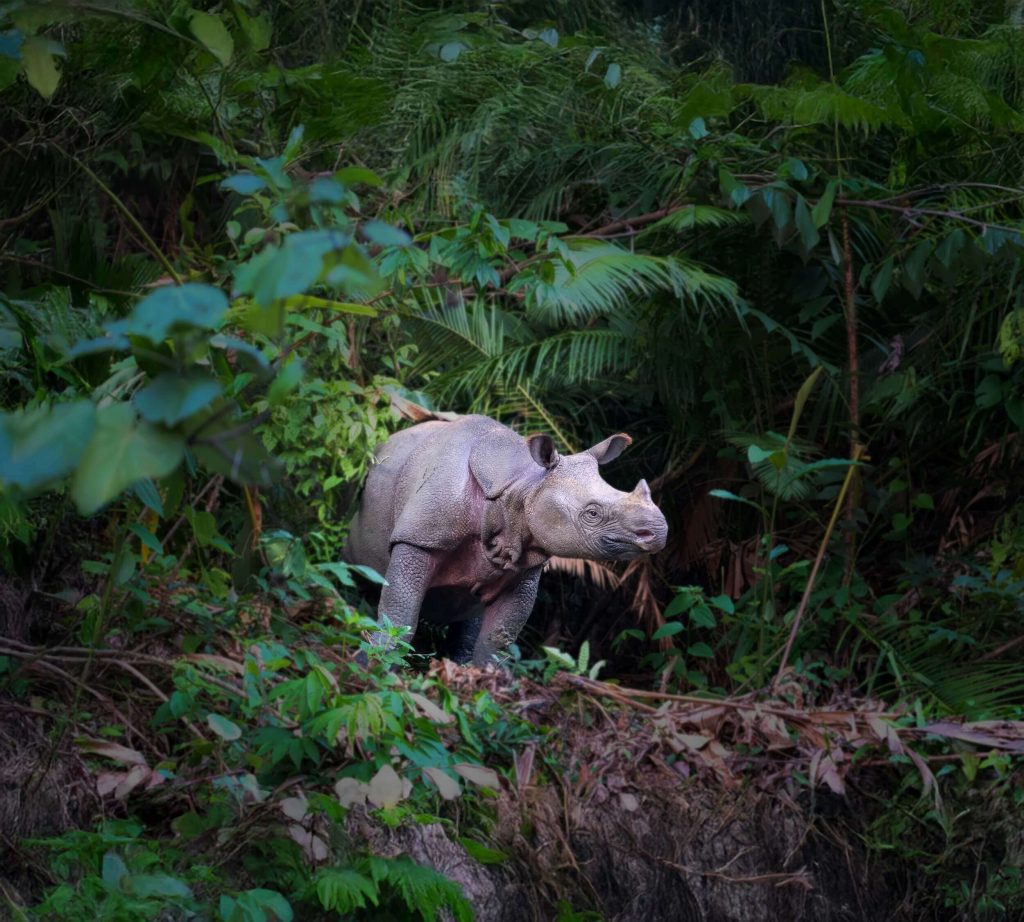
Years 1-3: help stabilise and protect the rhinos of Ujung Kulon National Park.
Protecting the world’s rarest rhinos through dedicated conservation efforts.
A Shared Purpose
Our Mission
To help strengthen the protection of the world’s last Javan rhinos in Ujung Kulon National Park (UKNP), enabling the population to stabilise and recover.
Our priority is to work with the Park Authorities to unite all existing rhino patrol teams under the Government of Indonesia’s 10 year management plan, ensuring all units are trained to the same standard, and that all future operations are coordinated.
We will support the Park to strengthen the Marine Patrol Unit, funding new maritime headquarters and new boats. We will support new technology and provide expertise to help the Park Authorities monitor and patrol the Park’s borders 24/7.
We will work with the Park and the community to recruit a new female ranger team. These rhino ‘close protection units’ will provide continuous protection to the rhinos, enabling real-time monitoring and round-the-clock security.
Following the example of mountain gorilla conservation in Rwanda, we will work with the Park Authorities to ensure that local communities derive significant financial and social benefits from their stewardship of Ujung Kulon National Park, via jobs, trade, payments for ecosystem services, benefits for conservation results, and future tourism benefits.
Key Performance Indicators provide critical accountability for all elements of the project. We will support the Government of Indonesia’s 10 year action plan to ensure that all work streams are accountable, and all are having a positive impact. Our priority will always be output metrics (results) not input metrics (resources).
We will engage with the Indonesian Academy of Sciences, UGM University and IPB University to support post-graduate research projects in and around UKNP, with a focus on ecological monitoring, biodiversity surveys and habitat management.
We will support and fund routine testing and vaccination for livestock near the park. We will work with the Park Authorities and local livestock herders to reduce, and ultimately eliminate, the practice of allowing buffalo – which transmit a fatal bacterium to the rhino – to roam freely inside the park.
We will work with local partners to reduce annual mortality in Ujung Kulon National Park to below 10%, which we will achieve through effective protection from poaching and veterinary diseases.
For the population to grow, approximately 20% of the remaining females must give birth every year, which is typical for a healthy population. We will work with local partners and the community to remove invasive plant species – such as the Arenga Palm – and reintroduce rhino feed plants, ensuring that the park continues to provide nutritious and abundant food for rhinos and other species.
Translocating rhinos to a second site is a vital part of the recovery process, as a single site is vulnerable to natural disasters, such as wildfires, tsunamis, or to an outbreak of lethal disease.
We will support the work of Indonesian Academy of Sciences, IPB University and local partners, to help the Park Authorities to identify which rhinos should be translocated to the new site, based upon their age, genetic profile and other factors.
Rhinoceros Sondaicus
The Javan rhino (Rhinoceros sondaicus) is one of three species of rhino to be found in Asia, alongside the greater one-horned rhino and the Sumatran rhino. The remaining two rhino species, the black and white rhino, live in Africa.
The Javan rhino once roamed widely across Southeast Asia, where its range overlapped with both the gargantuan Indian one horned rhino and the comparatively tiny Sumatran rhino. For hundreds of years, they were hunted for food, for their skins (which were used as armour) and for their horns, which were (and still are) believed by some to have medicinal properties.
With the arrival of western hunters, the plight of the Javan rhinos became more desperate. They were a popular trophy animal among the ruling elite, and were eventually classified as ‘vermin’ by the Dutch colonial administration, with a bounty on their heads because of the damage they caused to plantations.
Over the course of the 20th century they were slowly eradicated from the majority of their range, and by the 1980s were only found in two places: Ujung Kulon in West Java, and Cat Tien in Vietnam. In 2010 the body of the last remaining Javan rhino in Vietnam was discovered shot and de-horned, leaving Ujung Kulon as the last remaining holdout for the species.
Rhinoceros Sondaicus
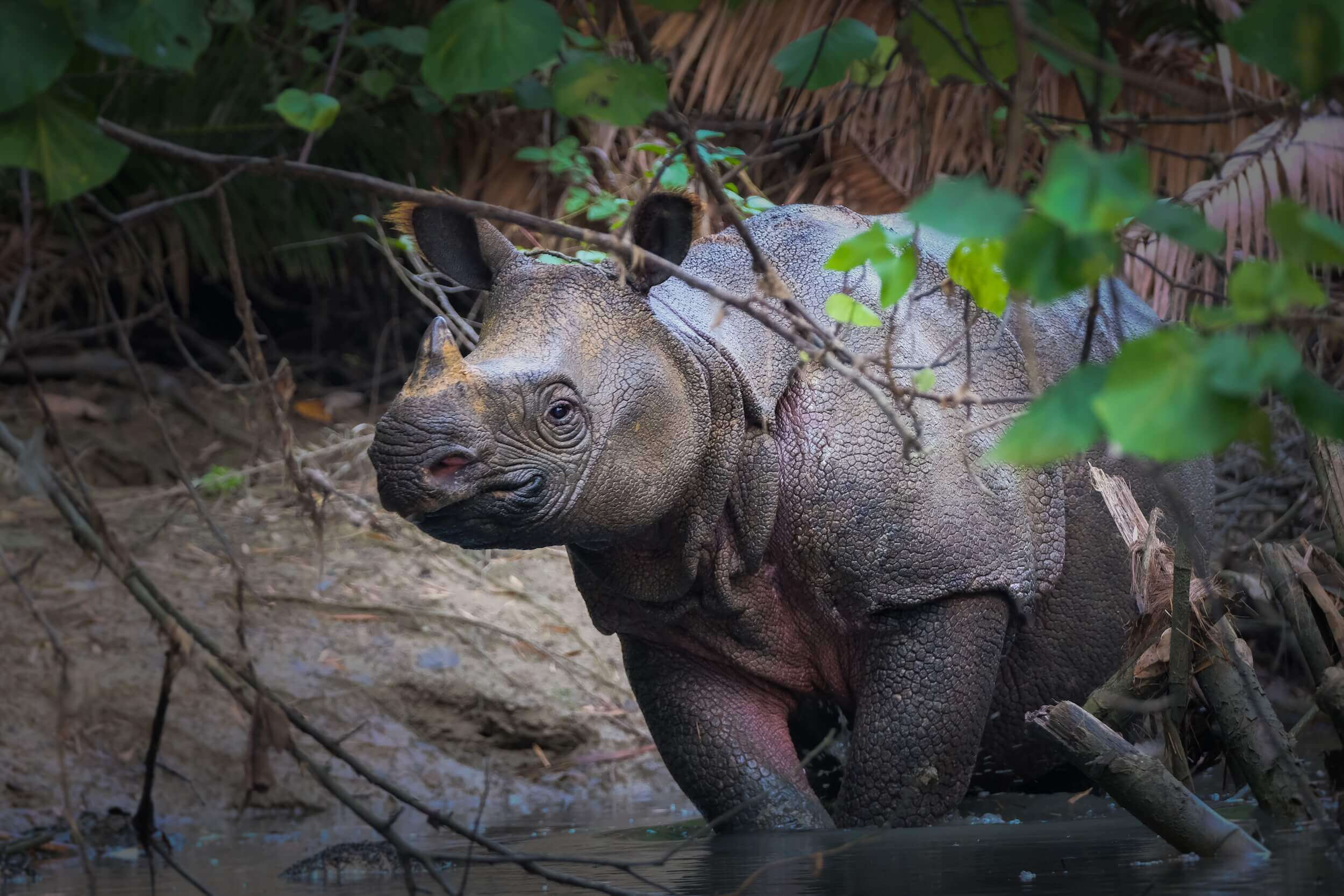
One of the rarest large mammals on earth, the Javan rhino weighs between 900-2,300kg, has grey or grey-brown skin. The male rhino has a single horn which is about 20cm long. Female rhinos don’t have horns, but can develop a small hardened bump on their nose. They are expected to live between 35 and 40 years in the wild, though remarkably little is known about their biology.
They are usually solitary, except for females with small calves or during their short periods of courtship when a female is in oestrus. In Ujung Kulon males have territories of 12-20 km² which only marginally overlap with other male territories, whereas the smaller female territories (3-14 km²) overlap each other considerably.
They spend a large proportion of the day wallowing in mud holes, essential for thermo-regulation, skin condition and getting rid of ectoparasites, deepening holes with their feet and horn.
Ujung Kulon National Park is the largest remaining lowland rainforest on Java located on the extreme southwest tip of Java. It covers 1056.94 km² of which 613.57 km² is terrestrial and 443.37 km² is marine protected area.
The habitat is a mixture of lowland rainforest, coastal forest, mangrove and grassland. In addition to Javan rhinos, the park is home to several iconic mammal species including banteng, Javan leopard, wild dog (dhole), leopard cat and three endemic primate species: the Javan gibbon, Javan leaf monkey and silvered leaf monkey. Over 270 species of birds have been recorded, including the rhinoceros hornbill and Javan eagle, while reptiles and amphibians include two species of python, two crocodile species and numerous frogs and toads.
Support the mission. Send us a message. Share the story.